“Leading from a rested heart is a must for leaders to be effective. Dr. Cris Uy, a global leader, embodies and lives it out and now allows readers to see and learn it through his personal journey. Vital lessons on sustainable leadership can be discovered here. Emerging leaders will benefit greatly learning from him.”
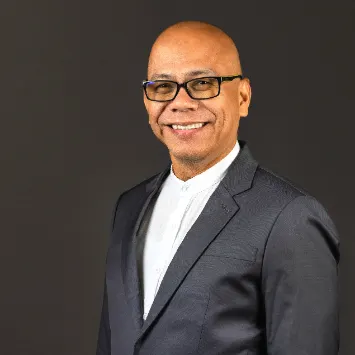
In the professional world, he is Dr. Cris Uy. But to many within his closer circles, he is our “Kuya Cris” (kuya is “older brother” in Filipino/Tagalog). One would find him humbly walking into meetings unassumingly. Only to find him contributing depth and much wisdom to the table. One would just know that his humility, composure, and wisdom come from an inner strength endowed by the Creator of the universe and honed through time by the many challenging situations along his journey. You can be sure that the leading from a rested heart he speaks about comes with weight and much credibility. After all, he led our school through the most uncertain and darkest times of the Covid pandemic, and he currently serves as Cru’s Vice President for Southeast and South Asia - working with the most diverse cultures in a region with the most people groups still to hear about Jesus Christ.
Kuya Cris, as a mentor and a predecessor who recently passed the baton of leading the International Graduate School of Leadership (IGSL) to me, is known to many as a person of authentic leadership - he simply practices what he preaches. The very principles and applications in his book he experienced and definitely has done it. This builds so much trust in his integrity as a global leader.
These days, younger leaders need all the mentoring they can get from more experienced leaders who have trodden the difficult path of growth in many aspects of life and leadership. We simply learn best not just from our own experience but also from the experiences of those who have done well through the pain, challenges, blessings, and breakthroughs of their life journey. Kuya Cris is one authentic leader many younger leaders can identify with and learn from.
You can read many books on leadership that tackle mostly the head and the hands. This book talks about the heart before the head and hands. It speaks about nurturing the soul of one’s leadership. I believe we can be more effective leaders that way. Excited to hear how leading from a rested heart and other learnings from Kuya Cris’s life and work would impact the way you lead. It has impacted mine.
Great Bayani Mabuti, PhD
President, International Graduate School of Leadership
A Steward of the Fragile Life
This book began in a funeral parlor.
I had gone to pay my respects to a good neighbor. Standing in that place of finality, I received a message that stopped me cold. J.I., the 28-year-old son of a dear friend and former colleague, had died of a massive heart attack. A life full of promise, gone in an instant.
In that quiet, the truth pressed down on me. Life is fragile, and it is short. I looked at my own. I was 58, and it occurred to me that every day I had been given was a loan from the Creator. He had blessed my journey with decades of leadership across continents and cultures, through seasons of expansion and seasons of deep trial.
I began to think about my own children and my son-in-law. I thought about the young team leaders rising through the national ministries of Campus Crusade for Christ, and the leaders who will carry the global Body of Christ after us. They are setting out on their own pilgrimages into a world more complex and demanding than the one I entered. And a hard question surfaced: am I stewarding these experiences, or merely accumulating them?
Knowledge hoarded dies. Knowledge sown multiplies. If I met my Creator today, would the lessons I learned, most of them through failure, go into the grave with me? Or would I leave a trail for those coming behind me?
I decided to leave something behind.
These pages are my private journals from 2016 to 2018, opened up and turned into a map. They are not the record of a finished man. They are the record of a fellow pilgrim still learning, on most mornings, what it means to lead from a rested heart.
May they serve you. And may you find that even in the fragility of life, there is a strength that comes from staying grafted to the Vine.
The Author
This book is a labor of love, made possible by a community that sustained me when my own strength and words were thin.
To my son, Samuel Uy: Thank you for being the first to believe in this dream. Your constant encouragement was the fuel I needed to move from merely thinking about these pages to finally seeing them published.
To my daughter, Danielle: Thank you for your patience and keen eye. You took my chaotic drafts and brought clarity and order to them, ensuring that the message of the “Rested Heart” was communicated with grace.
To my son-in-law, Liam: I am grateful for your technical wisdom. Your insights on how to utilize AI to critique and refine my work opened new doors for my writing process.
To my wife, Marlyn: You are my greatest partner. Thank you for the quiet ways you cared for me—for the countless meals and snacks you prepared while I was lost in my manuscript. Your support made the long hours of work a joy rather than a burden.
To my teammates and the national staff of CCCI: Serving alongside you is one of the greatest honors of my life. Thank you for your love and support, and for making my journey in the mission so incredibly meaningful and memorable.
And above all, to our loving God: Thank you for the privilege of stewardship. Any influence or role I have held is Yours alone. I am deeply humbled that You would use these pages for the expansion of Your Kingdom and the glory of Your Name.
Leadership is not a destination you reach. It is a pilgrimage you undertake, and the longer you walk it, the more you realize the terrain is mostly internal.
Over decades of serving as a global leader of Campus Crusade for Christ International, I have learned that the effectiveness of our external work, the conferences and the regional strategies and the teams we manage, depends entirely on the health of our internal world. This book is a collection of my personal journals from 2016 to 2018, the unfiltered reflections of a leader trying to stay grafted to the source of life while leading global operations across Southeast and South Asia.
These pages are written for the emerging leader. You are the one stepping into influence, perhaps feeling the weight of responsibility for the first time. My prayer is that you learn not only how to manage, but how to be.
The book moves through three dimensions of leadership. The first is internal: the foundational habits of the heart, including physical discipline, spiritual abiding, and integrity. The second is relational: the work of leading a family, working through conflict, and mentoring the next generation. The third is global: the complexity of leading across cultures, scaling operations, and enduring the hardships that ministry in a broken world makes inevitable.
A few words recur throughout this pilgrimage, and it helps to define them. The rested heart is a soul-stability achieved through discipline; not the absence of work, but the presence of peace within it. Grafted is a picture from John 15, describing a leader’s constant, deliberate attachment to Christ as the source of all life and direction. Crouching sin is the subtle predatory temptation, the pride, the need for credit, the instinct for self-preservation, that waits at the door of a leader’s heart as influence grows. And the culture of shame is a social dynamic, sharp in many Asian leadership contexts, in which saving face outranks truth and erodes integrity from the inside.
Too many emerging leaders are being taught to build towers to their own fame, to hustle until they break, to project the performance of competence in place of the substance of character. The result is leaders who are physically exhausted, emotionally isolated, and spiritually hollow. Leaders running at a racing heart rather than a rested one.
There is another way. A path where leadership is an act of worship, influence is built on the slow currency of trust, and success is measured not by a famous start but by a faithful finish. This is a fight for the soul of the leader: making sure that as your reach grows large, your heart stays grafted and small.
A race is won in training,
not at the gun.
The runner who falls apart at the wall did not lose it there. He lost it weeks earlier, in the easy miles he let slide. With leadership the early miles are internal ones.
Can your pulse hold steady at an inbox? Will your ego take an order from you? Are you still grafted to the Vine on the mornings you would rather sleep in?
Settle these questions here, and the rest of the race has ground to run on.
On December 31, 2016, while the rest of the world got ready for midnight, I was alone on a lone stretch of road in Ilocos Sur. The humidity was climbing, and my breathing had settled into a hard, even rhythm. Each strike of my shoe against the pavement felt like a small act of reclamation. When I finally slowed to a walk and looked at my watch, it read 50.23 kilometers. A full marathon, and then another five miles past it. Nearly six hours of continuous movement, at a steady shuffle of 9’52” per kilometer.
It was no record. But for a man who had once been a prisoner of his own stress, it was a victory.
Two years earlier, my resting heart rate had been anything but restful. My heart was a frantic drum, often climbing past 100 beats per minute (BPM) while I sat in a calm office reading an email. That is the heart rate of someone briskly climbing stairs. My engine was redlining while the car was parked. I looked composed on the outside; inside I was burning fuel I did not have.
I came to a conclusion. If I could not govern my own physiology, my leadership would not last. I could not lead 15,000 people toward a vision while my own heart raced at the sight of an inbox.
The road to a resting rate of 68 BPM was not gentle. It meant trading late-night noise for early-morning miles. It meant standing on that Ilocos road when every muscle begged for comfort. And it taught me something I did not expect: to lead from a heart at rest, you first have to train that heart under pressure. Peace is not the reward for avoiding work. It is what you earn in the discipline that comes before the work.
That changed how I walked into every meeting and every crisis after it. The miles I logged in the dark dawn gave me the capacity to carry the weight of the mission without my pulse dictating my decisions. A rested heart, I learned, is a leader’s real advantage. It lets you see clearly while everyone else is blinded by the dust of the race.
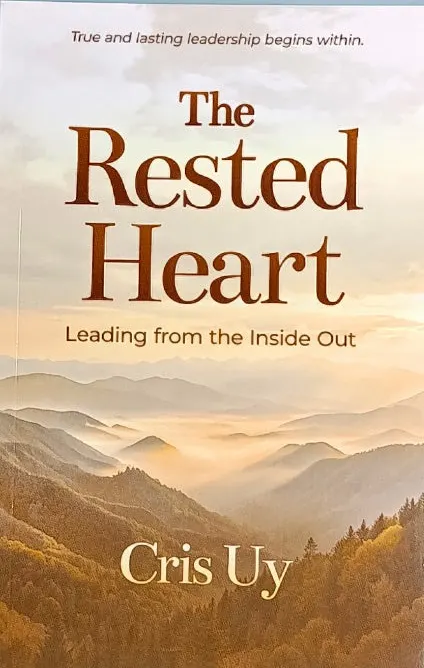
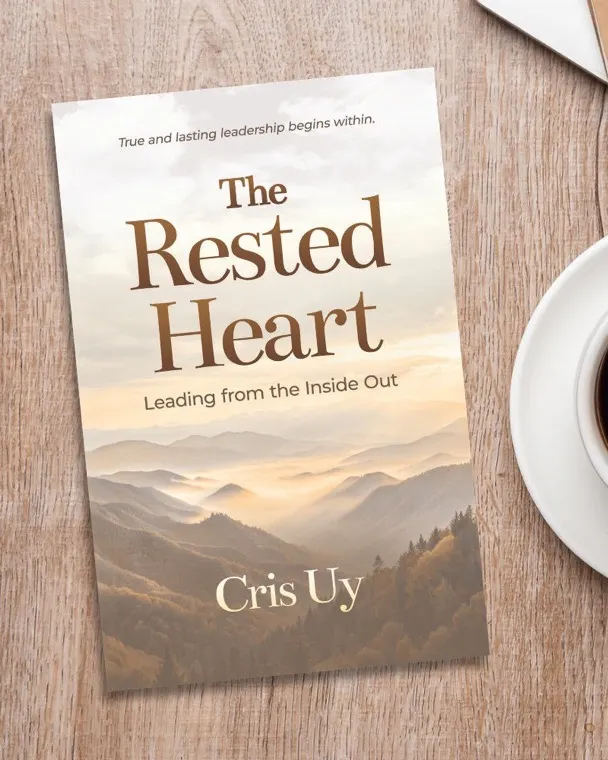
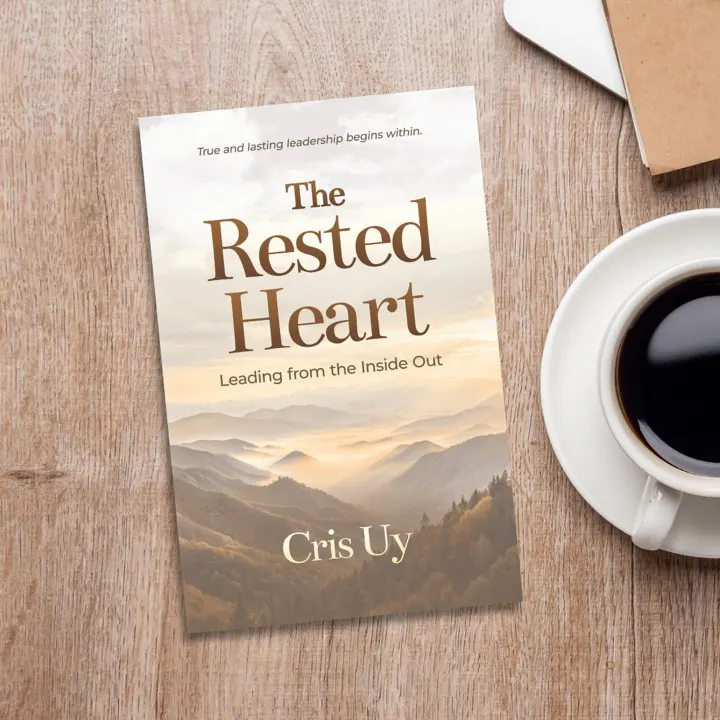
True and lasting leadership begins within.
The Rested Heart
Leading from the Inside Out
Cris Uy
CSM Publishing
Contents
Part one The Internal Foundation
- 1The Irony of the Rested Heart17
- 2The Currency of Trust20
- 3Subduing the Crouching Sin23
- 4The Work Before the Work26
- 5The Grafted Life29
- 6The Silence of the First Leader32
- 7Bridges, Not Towers35
- 8The Discipline of the Finish Line38
Part two The Relational World
- 9Learning to Pause43
- 10Your First Ministry46
- 11The Legacy of a Good Name49
- 12Passing the Baton52
- 13The Heart of a Servant55
- 14Stewarding the King’s Resources58
- 15The Strength in Vulnerability61
- 16The Courage to Reframe Failure66
107 pages · softbound
Keep reading
That’s the end of the sample. The book continues with Chapter 2, The Currency of Trust.
Get the book · ₱250
Amazon